
Dublin – A Tale of One’s City

Written by Niamh Martin
As a Dubliner, I have often wondered why Dublin has produced such a wealth of accomplished literary artists – including three Nobel Literature Laureates and three Booker Prize winners.
Over time, the outlook of the city itself has changed, with literary landmarks becoming increasingly visible across the city.
On a visit to my hometown, I explored the city to try and gain some insights into what makes Dublin such a literary powerhouse.
The young man from France shuffled uncomfortably, glancing quizzically at the man behind the bar counter who had just spoken to him. The conversation opener seemed to unsettle him.
“What’s the story, bud?”, the barman had asked. It’s a standard Dublin greeting, sometimes met with a bounce-back like “Grand, grand. Story with you?”. It’s a casual conversation starter with a nod to the city’s literary legacy. It’s an offhand quip that evokes creativity and, with the micro-beat between greeting and reply, a feeling that every encounter between Dubliners could start with a good story. But the poor, bewildered French man didn’t know that. He just wanted to order a pint of Guinness.
I’ve returned to Dublin from the UK where I have lived for 15 years and am sitting in Davy Byrne’s pub on Duke Street with some friends. An everyday pub with everyday Dubliners. The bar talk around me is of horse racing, death, weather, politics, the price of cheese. Everything and nothing. It’s mesmerising. Not for the first time on a trip back home, I am struck by the different way of communicating here that is at once lyrical, nuanced and ambiguous. Dublin author John Banville describes it as “Hiberno-English”, which he says emerged after
“the English language was imposed upon us, displacing the spoken Irish word, until we ended up with a blend of the two. We took the language of the coloniser and made something new, something rich and, sometimes, something strange out of it”.
John Banville, Dublin author
In many ways, Banville could have been describing the quintessential Dublin book, Ulysses by James Joyce. Variably described as “accomplished”, “momentous” but also “infuriating” and “unreadable”, Ulysses gradually reveals what amounts to being the detail of an ordinary day in Dublin for one of its residents, Leopold Bloom. While it is revered in varying measures for its stylistic acrobatics in describing the ordinary human condition, giving it a universally relevant theme, the novel is very much grounded in the streets of Dublin.
From his self-exiled position in Paris, Joyce could still communicate the mood and character of his hometown by referencing the physicality of Dublin, as well as drawing on a wealth of personal knowledge about its history and culture. For example, Joyce would meet his girlfriend, Nora Barnacle, at Merrion Square, outside the previous home of Oscar Wilde where Bram Stoker was a frequent visitor. Around the corner, on Lincoln Place sits Sweny’s Pharmacy, a famous reference in Ulysses and now a shrine to the novel, but which also used to be the serving pharmacy for Oscar’s father, Dr. William Wilde. On nearby Clare Street, Nora Barnacle would walk to meet Joyce by passing the place where Samuel Beckett’s father worked. If you knew and cared about those famous names, then this sometimes run-down city of Dublin could become something sacred. If you did not know or care, or were in a hurry somewhere, as characters in Ulysses often are, then it could just be an ordinary street, like any street in any city.
Although he left Dublin at the age of 22 and seldom returned, James Joyce was forever emotionally tethered to the city of his birth, declaring that
“when I die, Dublin will be written in my heart“.
James Joyce
He saw his native city as
“a city of poets, dreamers, and storytellers, where imagination takes flight”.
James Joyce
Here in the pub, among my friends, I am surrounded by people who are exchanging stories and tales with ease, one person’s yarn kick-starting another person’s memory. And so the evening goes on and on, one story follows another, because as Joyce has pointed out, we’re a nation of storytellers.
And it’s not just the ordinary folk of Dublin who spin a good yarn. On the global stage, Dubliners George Bernard Shaw, Samuel Beckett and William Butler Yeats have been honoured with the Nobel Prize for Literature. More recently, Dublin has produced three Booker Prize winners; Roddy Doyle, Iris Murdoch and Anne Enright, with another Dublin author, Paul Murray making the 2023 shortlist. Where has this knack for producing award-winning storytellers come from? Is it because writing is essentially an extension of talking, and the Irish just never quit chattering? Admittedly, it does feel that way sometimes. Perhaps the education system is producing highly literate, creative types? Or maybe it’s the long-term and inclusive financial support from the Arts Council? Could it also be the renowned collegiate Irish writing community helping to identify, encourage and assist new writers?
More likely, it is all of the above, and more. Personally, I’m inclined to think that other key factors are; “what” Dublin writers tell their stories about, and “why”, not forgetting their “Hiberno-English” way of telling it.
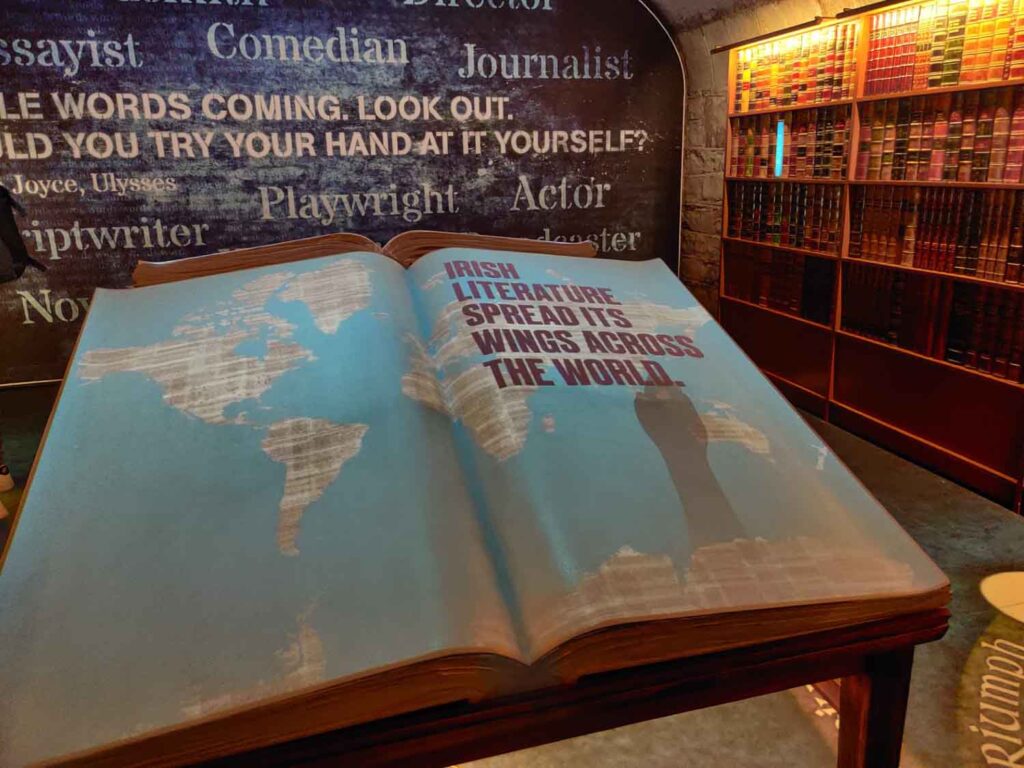
If writers write about the world around them then, in an Irish context, the society in which Irish people have lived during the past few centuries, has been disproportionately influenced by two hugely significant powers; the imperial influence of our colonisers, Great Britain, and later, after we had achieved independence as a country, the iron-clad grip that the Catholic Church held over the country and its politics. In many ways, both of these “administrations” contributed to a dysfunctional society, with its associated poverty, disharmony, inequity, violence and, in Ireland’s particular case, mass emigration. Plenty of source material there, you might think!
At the turn of the 20th century, partly to escape the misery of their existence and partly to meet with like-minded idealists, people (mostly men) began to congregate in pubs, to talk about the politics and happenings of the day. It was a means to debate and discuss the key issues and begin to identify solutions, ways to improve things. These pubs were also the meeting places for creative types like writers and journalists who contributed, but also listened to and absorbed the language, the issues being debated and the colourful characters speaking about their lives.
Popular pubs for these alcohol-fuelled discussions were McDaids, Kehoes and O’Donoghues (all located near Grafton Street). For research purposes only, I make a stop at McDaids for an afternoon beverage and find a place that revels in its literary history, still serving drinks from behind the original wooden counters to paying customers perched on high stools, just as they did to poet Patrick Kavanagh and playwrights Sean O’Casey and Brendan Behan. The pub still feels so “olde worlde” that it is not hard to imagine the scene of boisterous discussion that dominated during the early years of the Irish Republic, producing plays such as Borstal Boy and The Plough and The Stars.
In his short-story collection, Dubliners, James Joyce places his characters in pubs around the city that are still serving drinks today, over 100 years later; O’Neills in Suffolk Street, Davy Byrne’s in Duke Street, The Oval in Middle Abbey Street and Mulligan’s in Poolbeg Street.
Earlier in the 19th century however, Ireland’s new Independent State was still a long way off, and organised debates and discussions were considered the domain of the privileged and educated. One venue for such hot-bed discussions was number one Merrion Square, the childhood home of the great literary wit, Oscar Wilde.
Now part of American College Dublin, Oscar Wilde House is a museum, open for tours during holidays and at weekends during term-time. I take a tour with Martin Burns, Museum Director, and see first-hand where Lady Jane Wilde (Oscar’s mother, also known as the poet, Speranza) held weekly debates and discussions in the drawing room. Over one hundred people attended, including writers, scientists, poets, politicians and actors, exerting a similar influence to that of London’s Bloomsbury Group. This was the world that Oscar moved in, listening to debates, hearing opposing opinions and giving him the opportunity to practice his captivating oration and communication skills.
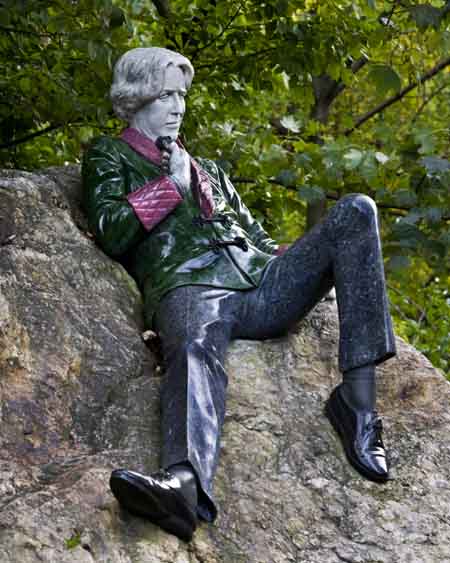
Walking through these rooms, it is hard not to be touched by this building and its place in history. The context and make-up of its gatherings provide some real insight into why Dublin proliferated with quality writers during the late 1800’s and early 1900’s. Bram Stoker, Dracula author, was a regular at these debates. and although he lived nearby in the grandeur of newly built Georgian townhouses, he worked as a civil servant in Dublin Castle, in the city’s medieval and Viking quarters.
A century earlier, in this medieval part of the city, known as The Liberties, Jonathan Swift, author of Gulliver’s Travels was appointed the Dean of St. Patrick’s Cathedral. Here, in the narrow streets that radiate from the old Viking settlement between Dublin Castle and Christchurch Cathedral, centuries of mixed history lie just below the surface. Its dark, brooding streets and foreboding atmosphere are known to have influenced the writing of Swift as well as Bram Stoker. On a previous trip, I have explored with creepy fascination the crypts of St. Michan’s Church (Church Street) where the mummified remains on display likely fed Stoker’s fertile imagination about the afterlife. For fans of Dracula and all things Gothic, Dublin City Council have an annual Bram Stoker Festival which runs in Dublin for three days in October.
To enter Jonathan Swift’s world, go to the medieval St. Patrick’s Cathedral. A guided tour, included in the admission fee (€10), is highly informative and entertaining. It provides key insights about the writer who was Dean here from 1713 to 1745 and is also buried here. Gulliver’s Travels was not written to woo or entertain, but more as an indictment of the insensitivities and poor decision making of the leading politicians, scientists and philosophers of the day, particularly in relation to the extreme poverty that was rampant in this area of Dublin.
Next door to St. Patrick’s is Marsh’s Library, the first public library in Ireland, opened in 1707. Its interior has not changed in over three centuries, meaning the chairs in the Reading Room are the very ones Bram Stoker sat on when he came here in the 1870s to read about Transylvania and the historical figure of Dracula. Joyce and Swift were other regular visitors, while records show that Sir Walter Scott was also a visitor in the early 19th century.
Dublin in the 21st century continues to be a hub of literary genius. Over the past 50 years, writer’s themes have continued to echo their living circumstances and issues of the day, such as Roddy Doyle’s depiction of 1970s and 80s suburban Dublin. More recently, authors such as Sally Rooney, Anne Enright and Joseph O’Connor reflect Dublin as an outward looking city with 21st century global themes such as grief, intimacy, identity, friendship, class inequality and motherhood.
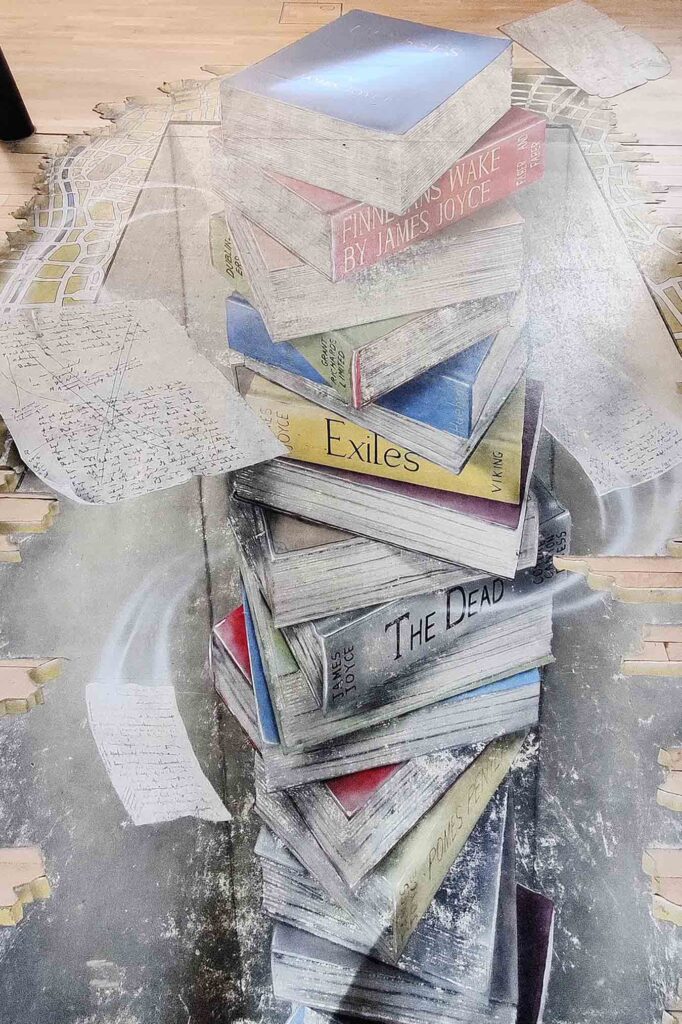
A recent addition to the Dublin literary scene is the wonderful Museum of Literature Ireland, or MoLI (an intentional literary reference to Ulysses!). MoLI is a veritable trove of literary gold and certainly worth the €13 entry fee.
“We have worked hard to provide a space where the past and present literary worlds can be present simultaneously”
Simon O’Connor, Director at MoLI, tells me. To illustrate this, the museum hosts a permanent Joyce exhibition and a rotating exhibition space for contemporary authors. The Reader’s Garden is a sensory oasis, a place to sit and absorb the inescapable aura of literature permeating throughout this museum.
So, what have I learned about the literary heritage of this capital city, why has it become a bastion of quality writing? Dublin feels like a city that embraces and respects its writers. On an official level, support is provided through the Arts Council and it is also home to the largest literary prize in the world (Dublin Literary Award). Even as a casual visitor, literature feels like something you can take part in. Try spotting the numerous writer’s statues dotted around the city, the Beckett Bridge that connects both sides of the city, visit the abundant independent bookshops (Winding Stair, Chapters, Books Upstairs) and take part in the ever-enjoyable literary pub crawls. Or simply sit with some friends in a cafe, pub or park and listen to the everyday chatter that vibrates around this lyrical city. This breadth and range of literary experiences in Dublin make it a “must-see” on any bibliophile’s bucket list.
Will I be back? With a nod to the final words in the quintessential Dublin book, the answer is
“Yes, I will, yes”.
James Joyce, Ulysses
Press here to read a comprehensive list of Dublin’s Literary Attractions.
Press here to read about Bram Stoker’s Dublin.
Don't Miss
Museum of Literature Ireland (MoLI). Adults €13
St. Patrick’s Cathedral – for Jonathan Dean Swift fans. Adults €10, children €4.50
Marsh’s Library – see what a library from the 1700’s looks like. Adults €7, U-18’s free.
Literary Prize Dubliners
Nobel Prize for Literature:
George Bernard Shaw
William Butler Yeats
Samuel Beckett
Booker Prize:
Anne Enright
Roddy Doyle
Iris Murdoch
Literary Hotels To Stay At
Shelbourne Hotel – ££££
Motel One Dublin – ££